Rates & availability change: Phinisi Lemo Lemo is an independent guide and commissioning service that connects international buyers to vetted Bugis-Makassar shipyards in Bira, Tana Beru, and Lemo Lemo — we are not a single named yard and not a government body. All prices and timelines are ESTIMATE RANGES (USD) flagged with the date last verified, project-specific, and confirmed by the yard after design and survey. Ownership, flag, and cabotage notes on this site are general information, not legal or tax advice; retain a maritime lawyer. If you proceed with a partner we introduce, they may pay us a referral fee at no extra cost to you.
Phinisi wood refers to the specific structural and interior timbers used in traditional Bugis-Makassar phinisi shipbuilding: primarily kayu besi ironwood, teak, and bitti. These woods are chosen not for romance alone, but for how they behave under load, in saltwater, and across decades of hard use.
What “Phinisi Wood” Actually Means
In the Konjo shipwright tradition of Bira, Tana Beru, and Lemo Lemo, “kayu phinisi” is not a single species. It is a system of woods, each assigned a role in the hull, frames, deck, and interiors.
Today, most seaworthy phinisi in the 25–50 m LOA range are built from a combination of:
- Kayu besi (ironwood) for keel, backbone, frames, and critical structural members.
- Teak (jati) for decks, exterior joinery, and higher-end interiors.
- Bitti (Vitex cofassus and related species) for planking, frames, beams, and deck structures.
Other regional hardwoods still appear in non-critical areas, but ironwood, teak, and bitti form the core phinisi materials palette for serious ocean-going projects.
The Three Pillars of Phinisi Materials
1. Kayu Besi Ironwood: The Backbone
Kayu besi, literally “iron wood” in Indonesian, is the traditional skeleton of a phinisi. In South Sulawesi, shipwrights use several dense hardwoods under this colloquial label, selected for weight, durability, and resistance to marine borers.
Properties & Performance
- Density: So dense that fresh-cut timber often sinks. This mass adds stability to the hull.
- Durability: High resistance to rot, fungi, and teredo worms when properly seasoned and immersed.
- Strength: Excellent compressive and bending strength for keels, floors, and frames.
- Movement: Low dimensional change when seasoned slowly, which is critical for long keels and scarf joints.
Shipwrights in Bira and Lemo Lemo still prefer large ironwood logs for the lunas (keel), gading (frames), and structural stringers. A clean, straight keel in kayu besi is one of the most heavily negotiated items in a newbuild contract.
Drawbacks & Trade-offs
- Workability: Difficult to cut and shape; it wears tools quickly and demands skilled carpenters.
- Weight: Heavy hulls are more comfortable at sea but can impact speed and fuel efficiency if overbuilt.
- Cost & scarcity: Large, high-grade pieces are more expensive and subject to tighter sourcing controls.
2. Phinisi Teak (Jati): Decks & Prestige
Teak is not native to South Sulawesi’s phinisi districts, but it has become the prestige choice for decks and high-visibility surfaces in export-focused yachts and small cruise ships.
Properties & Performance
- Natural oils: Teak’s oils give it good resistance to water and surface decay.
- Dimensional stability: Moderately stable; suitable for decking and joinery with correct fastening.
- Workability & finish: Easier to work than ironwood, takes a fine finish, and ages to a silver-grey if left untreated.
- Aesthetic value: Buyers often expect “phinisi teak” decks; it has become a visual shorthand for quality.
Where Teak Is Typically Used
- Main and upper decks (solid or laminated planks, often 18–25 mm thick on yachts).
- Cap rails, exterior seating, and trim.
- Interior flooring, cabinetry, and paneling in higher-spec builds.
Many working cargo phinisi still run entirely without teak, using bitti or other hardwoods throughout. On export yachts, teak is more common but rarely used for the entire hull; the cost-to-benefit ratio for fully teak structural members is poor compared to ironwood and bitti.
3. Bitti: The Workhorse of Phinisi Construction
Bitti is the quiet hero of modern phinisi construction. In Bugis-Makassar yards, it is valued for its balance of strength, workability, and relative availability.
Typical Uses
- Hull planking (especially above the waterline).
- Frames and deck beams in conjunction with ironwood.
- Superstructures, bulwarks, and interior partition framing.
Properties & Performance
- Strength-to-weight: Strong enough for primary structure without becoming excessively heavy.
- Durability: Good performance in marine environments with proper paint or oil systems.
- Workability: More forgiving than ironwood, allowing finer shaping and faster progress on complex curves.
- Cost: Typically more economical than teak, especially in large sections.
Comparing Ironwood, Teak & Bitti in Phinisi Building
| Factor | Kayu Besi Ironwood | Teak (Jati) | Bitti |
|---|---|---|---|
| Primary role | Keel, frames, backbone | Decks, trim, interiors | Planking, beams, superstructure |
| Relative density | Very high | Medium–high | Medium |
| Rot & borer resistance | Excellent | Very good | Good–very good (with coatings) |
| Workability | Poor (hard to work) | Good | Good |
| Typical cost impact* | High for large keel sections | High for decking/interiors | Moderate, budget-friendly |
| Best for | Long-life structural security | Owner comfort & aesthetics | Balanced structure & cost |
*Cost ranges are project-specific and must be confirmed with the yard; see below for indicative budgets (last verified June 2026).
How Konjo Shipwrights Combine These Woods
Konjo carpenters build phinisi from the keel up on the beach, by eye and experience. Wood selection follows this order:
Backbone & Frames
- Keel, stem, sternpost: Almost always kayu besi ironwood, scarfed from several massive timbers if necessary.
- Frames: Combination of ironwood and bitti, with ironwood reserved for high-load and grounding-prone areas.
- Floors and stringers: Mixed ironwood/bitti depending on design, operating draft, and budget.
Planking & Decks
- Underwater planking: Typically bitti or another durable hardwood, heavily caulked and painted.
- Above-water planking: Bitti with selected ironwood accents or reinforcements.
- Decking: Bitti or teak; export yachts increasingly specify teak for main guest decks.
Interiors & Superstructure
- Structural superstructure: Bitti frames and beams, occasionally ironwood posts.
- Interior finish: Teak veneers or solid teak where budget allows; otherwise other hardwoods stained or oiled to match.
If you are commissioning a phinisi, the technical drawings may be prepared by a naval architect outside South Sulawesi, but the wood choices will be debated daily on the beach. Our role at Phinisi Lemo Lemo is to translate between owner expectations and Konjo yard practice so that your “phinisi materials” spec is culturally realistic and structurally sound.
Wooden Dowels (Treenails) & Traditional Joinery
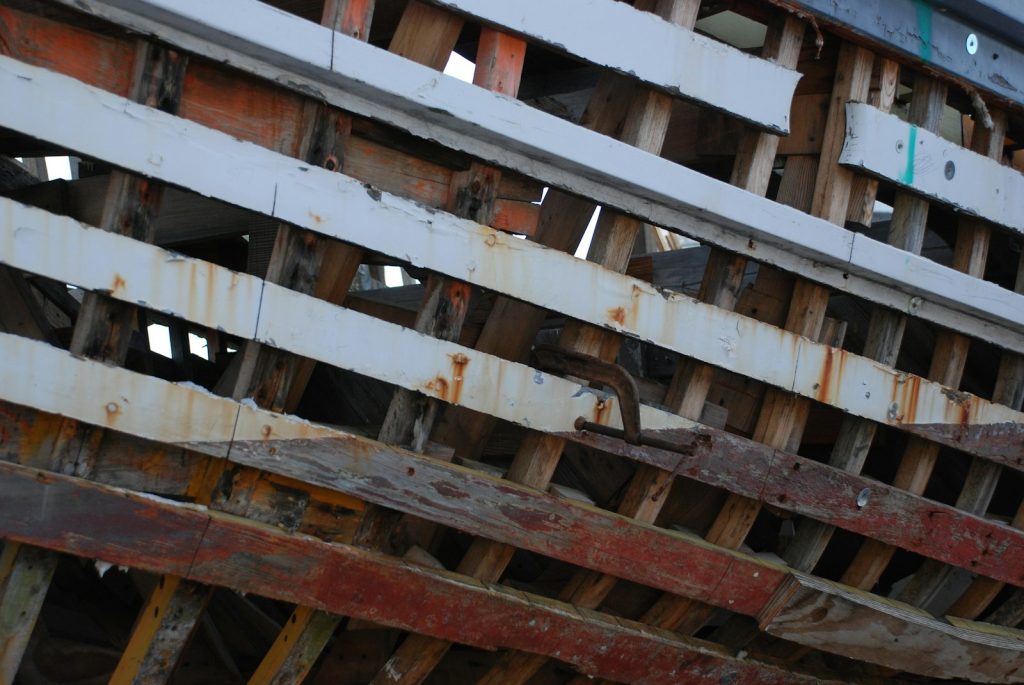
Phinisi hulls remain largely fastened with wooden dowels rather than metal screws. Locally, these are called pasak or dowel kayu, and they are central to the integrity of a traditional hull.
Why Wooden Dowels?
- Corrosion avoidance: Wooden fasteners eliminate galvanic and rust issues in constantly wet timber.
- Elasticity: Dowel joints move with the hull as it works in a seaway, reducing stress concentrations.
- Maintenance logic: Individual dowels can be removed and replaced during major refits without tearing apart large sections of hull.
How They Are Used
- Dowels are driven through planks into frames, often slightly oversize to create a tight mechanical lock.
- In critical joints (keel scarfs, stem joints), dowels are used in combination with through-bolts and modern adhesives if the design calls for it.
- The wood for dowels is carefully chosen for toughness and dimensional stability; it is not always the same species as the main hull planking.
For modern classed or commercially registered vessels, we increasingly see a hybrid approach: traditional dowels combined with stainless or galvanized bolts in high-load or regulatory-critical areas. This is defined by the surveyor, flag requirements, and design engineer—not by tradition alone.
Indicative Cost Impact of Phinisi Wood Choices
All figures below are indicative ranges in USD, last verified June 2026 from recent projects, and must be confirmed yard-by-yard. They are not quotations.
1. Baseline Hull & Structure Materials
For a typical 30–40 m LOA phinisi hull (cargo-style hull form, yacht-standard finish to come later):
- Ironwood, bitti & associated structural timbers: ~US$120,000–250,000 in timber cost, depending on size, timber grades, and sourcing distance.
- Labor for hull & structural assembly: Commonly exceeds timber cost; for serious export builds, hull and basic structure labor and materials might sit in the ~US$350,000–700,000 bracket before machinery and systems.
2. Teak Decking & Interior Upgrades
If you specify “phinisi teak” extensively, you should plan for a noticeable budget step:
- Teak main decks only (solid planking): Commonly adds ~US$40,000–100,000 over a bitti deck on a 30–40 m vessel.
- Teak interior floors & selected joinery: Often another ~US$30,000–80,000, highly design-dependent.
- Fully teak-intensive fitout (multiple decks, luxury interior): Material delta can exceed ~US$150,000–250,000+ compared with a bitti-dominant alternative of similar layout.
3. Project Duration Implications
Wood choices also influence build time:
- Ironwood-heavy structures: Slower to work; allow several additional months of hull construction if large sections are specified.
- Teak-rich interiors: Skilled joinery teams may add 4–8 months to interior completion on complex yachts.
For a serious 35–45 m phinisi yacht, a realistic yard build timeline (keel laying to launch, excluding extended design phase) is often in the 18–30 month range, last verified June 2026. Timber selection is one of several drivers of where you land in that band.
If you want realistic numbers for your concept (guest capacity, intended flag, trading area), plan your trip to Bira / Tana Beru / Lemo Lemo or set up a remote call; we coordinate detailed estimates with vetted yards via email and WhatsApp.
Sourcing, Legality & Sustainability of Phinisi Wood
Any serious phinisi project today must address where its timber comes from and how it is documented. Regulations have tightened; the era of entirely informal sourcing is ending.
Legal Timber & Documentation
Indonesia uses a legality verification system for timber and downstream products (often referred to in export contexts as a form of SVLK). For phinisi builds, this typically means:
- Shipyards procuring from licensed timber suppliers with proper harvest and transport paperwork.
- Buyers requesting and retaining copies of timber invoices and legality documents for future flag or port-state inspections.
- Export- or class-oriented projects sometimes requiring more formal chains of custody than traditional cargo boats.
Phinisi Lemo Lemo is not a legal or tax advisor; we help you understand what documentation a yard can realistically provide and align that with what your flag state and insurers may expect, but final compliance questions must go to your maritime lawyer, surveyor, or flag administration.
Sustainability Realities
Phinisi building relies on large volumes of tropical hardwoods. From a sustainability standpoint:
- Ironwood: Large, old-growth pieces are increasingly scarce, often sourced from further afield and under stricter controls.
- Teak: Plantation teak is available; provenance and grading vary, which affects both ethics and performance.
- Bitti: Regionally important hardwood; responsible sourcing depends on supplier practices and regional forestry management.
We work only with yards prepared to engage with legal sourcing and documentation. No one can pay to change what we publish; if you proceed with our partner they may pay us a referral fee at no extra cost to you.
Design, Class & Flag: How Wood Choices Intersect Regulation
Traditional phinisi were un-classed working cargo boats. A modern phinisi yacht or small cruise vessel is often expected to satisfy a mixture of:
- Flag state requirements (for construction, fire safety, and lifesaving appliances).
- Classification society rules if classed (for hull scantlings, materials, and survey regimes).
- Coastal state cabotage rules in Indonesia, if operating commercially in domestic waters.
Wood & Regulation
- Some flags and classes still recognise wooden hulls but may require specific timber species or minimum structural dimensions.
- Use of combustible materials (including timber) in accommodation affects fire protection requirements.
- For wooden hulls operating as passenger ships, there may be additional constraints on routes, seasons, and numbers carried.
Nothing on this page is legal advice. Early in any serious phinisi project, we recommend a three-way conversation between you, a naval architect or surveyor familiar with Indonesian wooden construction, and the intended flag administration or class. We can help assemble that team and anchor those conversations in how yards in South Sulawesi actually build.
Tradition, Ritual & Material Choices
Konjo shipwrights do not separate material choice from culture. Wood is part of ritual, not just engineering.
Rituals Around the Keel & Wood
- Keel selection: The keel timber is often inspected and discussed by master builders, sometimes with a ritual specialist, before purchase.
- Keel laying ceremony: Offerings, prayers, and traditional recitations may be made at the moment the first timbers are joined on the beach.
- Prohibitions: Certain taboos around cutting, shaping, or stepping over key timbers are still observed in many yards.
These practices sit alongside laser rangefinders, smartphone calculators, and naval architects’ drawings. The art of phinisi building recognised by UNESCO lives in the human judgement of those shipwrights—their sense of grain, weight, and “feel” in kayu besi, bitti, and teak.
Working With Phinisi Lemo Lemo on Wood Specifications
Phinisi Lemo Lemo is an independent phinisi shipbuilding intelligence and commissioning service, rooted in Bira, Tana Beru, and Lemo Lemo. We are not a single yard; we work across multiple Bugis-Makassar (Konjo) shipyards and design offices.
How We Add Value on Wood Decisions
- Requirements mapping: Translate your concept, guest profile, and intended operating area into a realistic structural and finish spec.
- Yard shortlisting: Match you with builders whose experience and access to timber align with your project scale and timeline.
- Comparative costing: Obtain competing estimates for different combinations of phinisi wood (e.g., teak-rich vs. bitti-rich interiors).
- Site visits & supervision: Arrange visits, independent inspections, and progress reporting so you can monitor timber selection and storage.
To explore a project or research trip focused on phinisi materials and shipbuilding, plan your trip and we will follow up via email and WhatsApp to refine your brief.
Key Takeaways on Phinisi Wood
- Phinisi wood is a system, not a single species.
- Modern phinisi rely on a combination of kayu besi ironwood, teak, and bitti to balance strength, durability, and cost.
- Ironwood belongs in the backbone.
- Prioritise high-quality ironwood for keel and key frames; that’s where longevity and safety start.
- Teak is an upgrade, not a necessity.
- Teak decks and interiors are desirable but optional; many robust phinisi use it selectively to control cost.
- Bitti is the day-to-day workhorse.
- It carries much of the structure and superstructure, combining adequate durability with better availability.
- Legal and sustainable sourcing now matter.
- Expect to discuss documentation and supply chains alongside dimensions and price.
FAQs: Phinisi Wood & Materials
Can I build a phinisi entirely in teak?
Technically, many structural elements could be built in teak, but this is rarely sensible. A teak-only specification dramatically increases cost and can compromise the weight distribution that Konjo shipwrights expect. Most serious projects use ironwood for the backbone, bitti for a large share of structure, and teak more selectively for decks and interiors.
How long can an ironwood phinisi hull last?
With proper design, construction, and maintenance, ironwood-based hulls can remain structurally sound for several decades. Actual lifespan depends on load cycles, grounding events, maintenance discipline, and how the vessel is operated. Surveys and refits are still essential; phinisi are not “maintenance-free” even with kayu besi.
Is phinisi wood sourcing fully sustainable?
No large wooden vessel can claim zero impact. However, legal frameworks and market expectations are pushing yards toward documented, more responsible sourcing. You can specify legality documentation, request certain supply practices, and favour designs that use scarce timbers efficiently. We can help you understand what is realistic in South Sulawesi today.
Will my flag state accept a wooden phinisi hull?
Some flags do, some do not, and many impose specific restrictions. Acceptance may also depend on vessel size, use (private vs. commercial), and which safety codes apply. This is a regulatory question; you must consult your intended flag administration, surveyor, or maritime lawyer. We can share practical experience from past projects but do not give legal advice.
How do I start specifying materials for a new phinisi?
Begin with your intended use, budget, and operating waters, then work backward into structure and finish. A short concept call with us can clarify what level of ironwood, teak, and bitti is realistic, and which yards can execute it. Share your outline through our plan your trip page; we will follow up via email and WhatsApp with next steps.